🧭 Comprehensive Negotiation Model

Strategic, Psychological, and Relational Approach
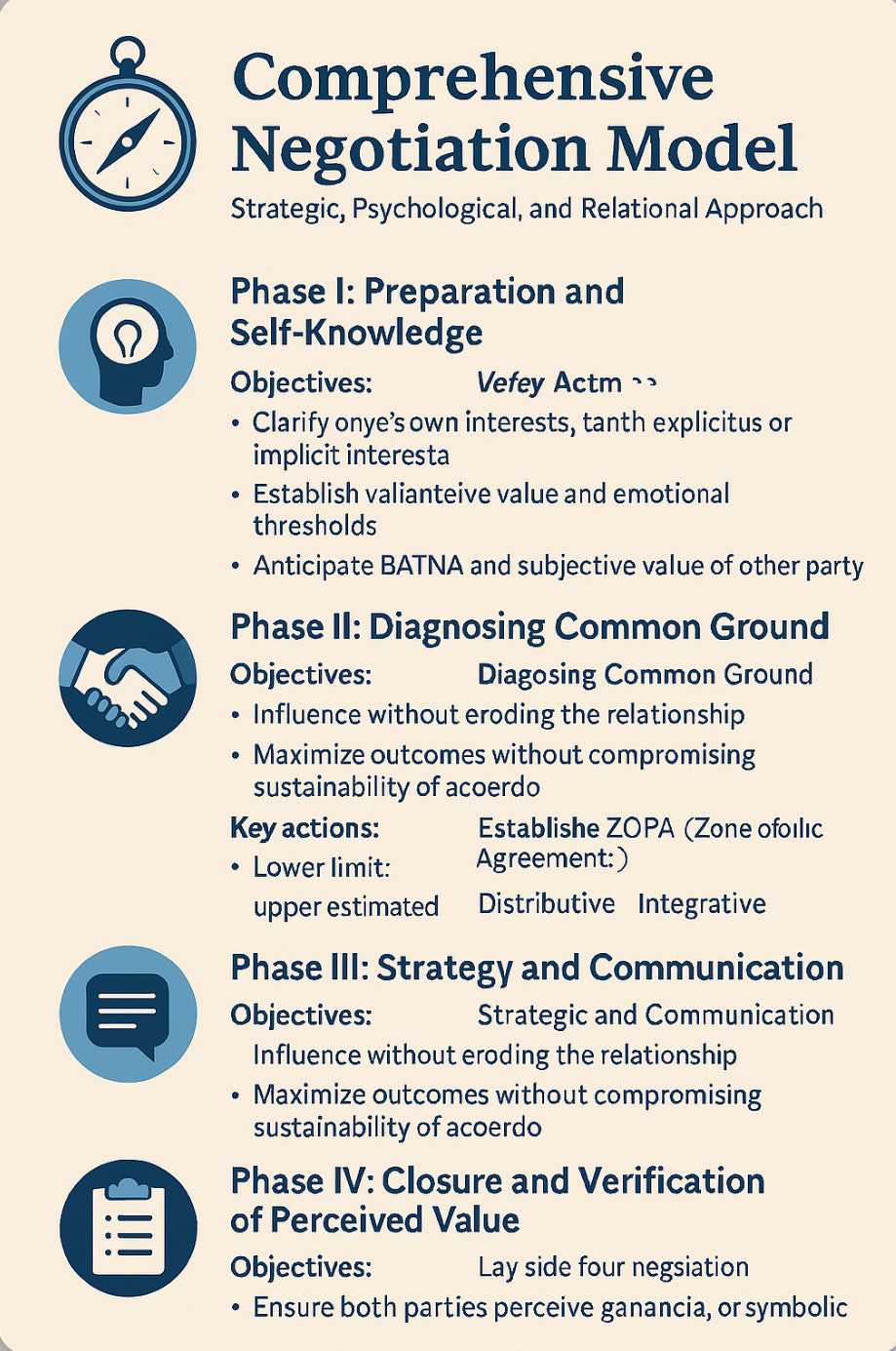
This comprehensive negotiation model integrates key concepts such as subjective value, distributive negotiation, the Zone of Possible Agreement (ZOPA), and the Best Alternative to a Negotiated Agreement (BATNA). Structured in phases, it is designed to support both professional negotiators and those navigating complex conflict resolution scenarios.
Negotiation is not merely an exchange of interests—it is a dynamic architecture of meanings, perceptions, and relationships. In interpersonal, corporate, or geopolitical contexts, negotiating requires navigating between rationality and emotion, power and empathy, the explicit and the symbolic. This model offers an integral framework that weaves together internal preparation, relational diagnosis, strategic communication, and value verification—aimed not only at reaching agreements, but at cultivating sustainable and conscious relationships.
🔹 Phase I: Preparation and Self-Knowledge
Objectives:
• Clarify one’s own interests, both explicit and implicit.
• Establish rational margins and emotional thresholds that define internal stability.
Key Actions:
• Define your BATNA (Best Alternative to a Negotiated Agreement): What will I do if no agreement is reached? This sets your minimum acceptable threshold and strengthens your negotiating autonomy.
• Identify subjective value: What intangible dimensions are at stake? (status, identity, trust, belonging, reputation).
• Anticipate the BATNA and subjective value of the other party: What might they consider valuable beyond price or explicit terms? This foresight allows for more resonant proposals.
To negotiate without knowing oneself is like sailing without a compass: one may move forward, but not know where one is headed.
🔹 Phase II: Diagnosing Common Ground
Objectives:
• Define the potential space for agreement.
• Recognize whether the negotiation is distributive or integrative in nature.
Key Actions:
• Establish the ZOPA (Zone of Possible Agreement):• Lower limit: your BATNA.
• Upper estimated limit: the best offer the other party might accept.
• Assess the negotiation type:• Distributive: Value is fixed; one party’s gain is the other’s loss. Requires tactical precision and ethical firmness.
• Integrative: Value can be expanded through strategic concessions, incorporating subjective elements of high value to one party and low cost to the other.
Common ground is not always evident; sometimes it must be cultivated through listening, intuition, and shared vision.
🔹 Phase III: Strategy and Communication
Objectives:
• Influence without eroding the relationship.
• Maximize outcomes without compromising the sustainability of the agreement.
Key Actions:
• Leverage subjective value as a strategic tool:• Examples: public recognition, flexible scheduling, emotional guarantees, reputational support.
• Manage distributive negotiations with tact:• Be firm in your margins, flexible in your approach.
• Apply tactics such as anchoring, reciprocity, and strategic pauses.
• Adapt to the behavior of the other party:• Read emotional, cognitive, or cultural signals that may shift value perception.
• Adjust rhythm, tone, and language according to relational context.
Communication is not merely the transmission of data—it is the creation of shared meaning.
🔹 Phase IV: Closure and Verification of Perceived Value
Objectives:
• Ensure both parties perceive gain, whether tangible or symbolic.
• Lay the foundation for future relationships.
Key Actions:
• Validate post-negotiation subjective value:• Do both parties feel they gained something meaningful, even if intangible?
• Review the agreement in relation to BATNAs:• Does the outcome exceed your alternative in concrete or emotional terms?
• Document key learnings:• Extract patterns, errors, and insights to strengthen future negotiations.
A successful closure is not merely a signed agreement, but a strengthened relationship and an expanded awareness.
This model is adaptable to diplomatic, corporate, or personal negotiations, integrating strategic elements with a deep understanding of relational psychology.