Jacobo Grinberg’s Neuroalgorithm

Jacobo Grinberg-Zylberbaum called neuroalgorithm the set of neural processes [the neuronal field] that make possible the translation of information from the field of reality (what he referred to as the “lattice of space” in his Sintergic Theory) into conscious experience.
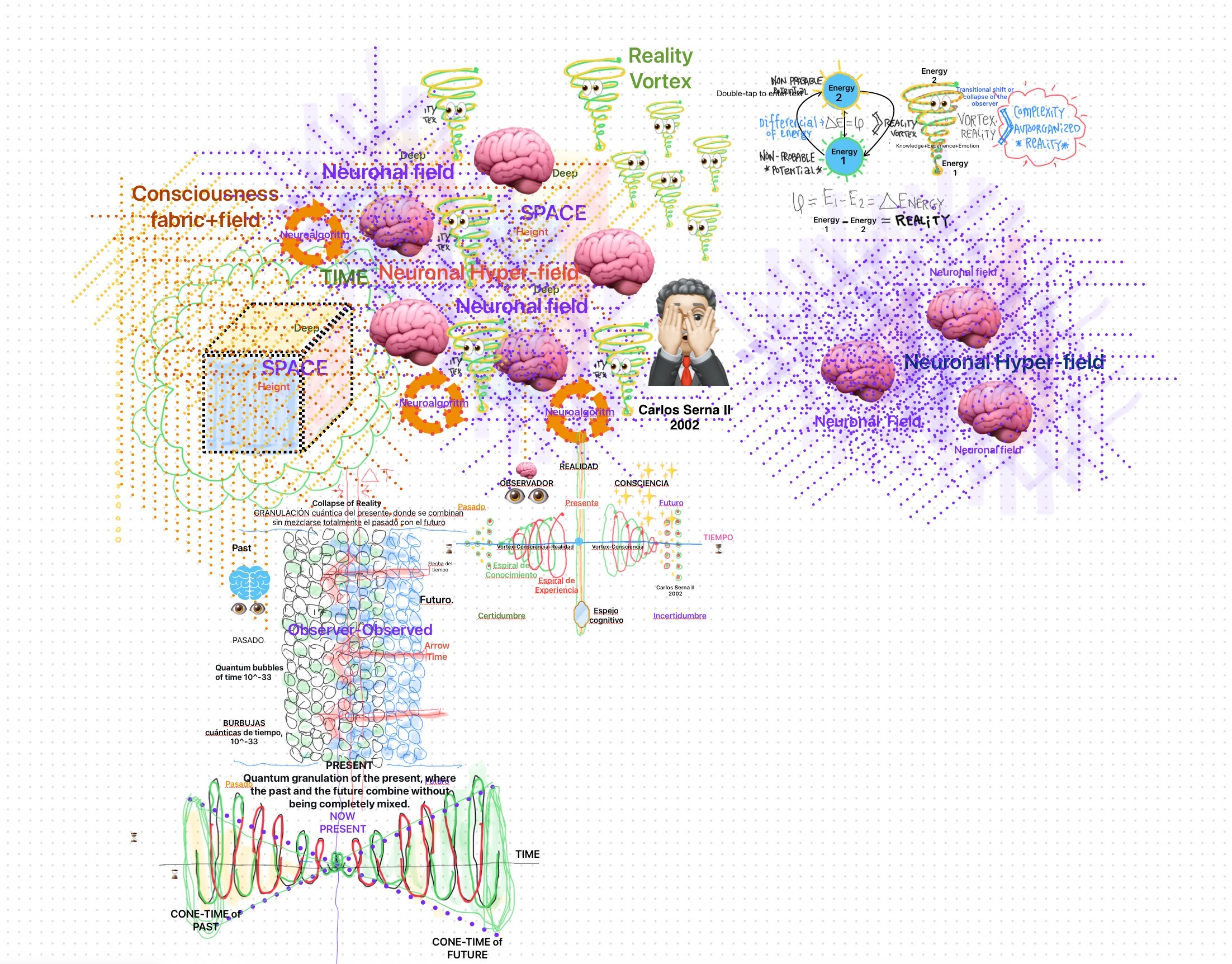
It is not an algorithm in the rigid computational sense, but rather a dynamic sequence of neurophysiological operations that allow physical stimuli to be transformed into the integrated perception of reality.
Put simply: it is the organizational pattern of the brain that generates the perception of the world and of ourselves—a kind of biological software embedded in neural hardware [organic wetware].
Before continuing, let us briefly refresh our understanding of algorithms. An algorithm is a sequence or pattern of well-defined instructions that, individually or together, may lack intrinsic meaning, but through their interaction allow the resolution of a problem or the execution of a specific task. In programming and AI, algorithms are essential for processing data and transforming it into coherent information for decision-making and process automation.
There are many types of algorithms—from simple ones, such as sorting and searching, to more complex ones, such as optimization and machine-learning algorithms (Mitchell, 1997). In AI, machine learning is built upon algorithms capable of detecting patterns from data (inductive) without being explicitly programmed for every task (deductive).
While algorithms attempt to integrate the three main forms of acquiring knowledge, we must not forget: deductive reasoning moves from general principles to specific conclusions; inductive reasoning builds generalizations from observed patterns; and abductive reasoning (the most complex) proposes the most plausible hypotheses when confronted with trends within already-integrated sets of information.
With the exception of abductive reasoning, these approaches have been incorporated into different branches of AI, with specific applications in rule-based systems, machine learning, and problem diagnosis.
2. Basic Operation. The neuroalgorithm operates as an active translation mechanism between two domains:
2.1. The quantum field of reality (the lattice), a network of informational potentials that is not, in and of itself, a human percept.
2.2. Conscious experience, which arises when the brain, through neuronal coherence, decodes the interaction between its own physio-bio-electromagnetic field and the Neuronal Hyperfield—a global field formed by the sum of all individual neuronal fields present wherever human beings are. It is at this junction that personal and collective experience encounter the invisible web of information, the lattice.
This process unfolds in three main stages:
• Reception of sensory signals → what we perceive are not direct copies of the external world, but perturbations emerging from the lattice, an invisible field of information.
• Cortical integration → the brain’s physio-bio-electromagnetic flows generate interference patterns that “carve out” or select fragments of that invisible reality, rendering them recognizable.
• Production of perceptual experience → conscious perception resides neither exclusively in the lattice nor in isolated neurons, but emerges from the dynamic interaction between the two, mediated by the neuroalgorithm: an organized set of brain processes that, when functioning in coherence, constitute the Neuronal Hyperfield.
3. Main Features
• Constructivist: what we perceive is not the world “as it is,” but the product of our neural networks’ algorithmic decoding—the neuroalgorithm.
• Flexible and plastic: the neuroalgorithm can be modified through learning, meditation, shamanic states, or consciousness-expanding practices.
• Coherence as a key factor: higher degrees of neuronal coherence yield more unified, profound, or subtle perceptual experiences.
• Interface between fields: it mediates the interaction between “fundamental reality” (a formless field) and individual consciousness.
4. Connections with Shamanic and Mystical Practices. Grinberg-Zylberbaum observed that in shamanic states (e.g., with Pachita or in deep meditation), the neuroalgorithm becomes self-referential, reorganizing itself in a feedback loop. This is, in essence, how we learn and gain new knowledge through the process called experience. In these states:
• Neuronal coherence expands.
• Access to “perceptual orbits” beyond the ordinary range becomes possible.
• The individual perceives dimensions of reality normally inaccessible.
He connected these phenomena to his theory of transpersonal information fields, where consciousness may access collective planes (akin to Jung’s collective unconscious or Bohm’s implicate order).
5. Relationship with Contemporary Neuroscience. Although Grinberg-Zylberbaum’s terminology is unique, the concept of the neuroalgorithm resonates with modern frameworks such as:
• Predictive Coding / Free Energy Principle (Friston, 2010): the brain as a predictive machine that generates models of the world to minimize surprise.
• Neural correlates of consciousness (Koch & Tononi): specific neural patterns sustaining conscious experiences.
• Dynamic networks and neural synchronization (Singer, Varela): oscillatory coherence (gamma, theta) as the foundation of perceptual unification.
In many ways, Grinberg’s neuroalgorithm anticipated contemporary debates on how the mind constructs reality and experience. Later theories can arguably be seen as refined extensions or approximations of what Grinberg had already articulated, even including models of artificial intelligence.
6. Philosophy and Phenomenology
From a phenomenological standpoint, the neuroalgorithm underscores that:
• Perception is not a mirror of reality but its construction.
• What we call “objective reality” is already the product of brain activity.
• Consciousness cannot be reduced to the brain alone, since the brain is but an instrument that translates and interprets the fundamental field of information—the lattice.
For Grinberg-Zylberbaum, the neuroalgorithm is the natural mediator between the infinitude of the real and the finitude of our experience. It is the bio-software that the wetware-brain uses to construct and co-create the perception of reality.
7. Implications
1. Epistemological: science never observes “reality in itself,” but only what its own neuroalgorithm allows it to construct.
2. Psychological: alterations of this algorithm (trauma, drugs, meditation) radically transform experience.
3. Spiritual: by expanding neuronal coherence, the neuroalgorithm can open pathways to states of unity with the whole.
✨ In summary:
Jacobo Grinberg’s neuroalgorithm is the organizing function of brain activity that enables conscious perception. It does not copy reality but co-creates it in interaction with a fundamental field of information (the lattice). Its plasticity accounts for the diversity of human experiences, ranging from the everyday to the mystical.