Knowledge, Experience, Emotions. Part I

The Alchemy of Emotions
Introduction
Unpleasant emotions, though commonly labeled as “negative,” are an essential part of the human condition. They constitute the raw material from which our inner and outer lives are shaped. Their function is not only to warn us of dangers or show us discomforts, but also to point out the limits of our understanding and the thresholds of transformation.
Integrating Unpleasant Emotions: Knowledge and Experience as Vital Alchemy
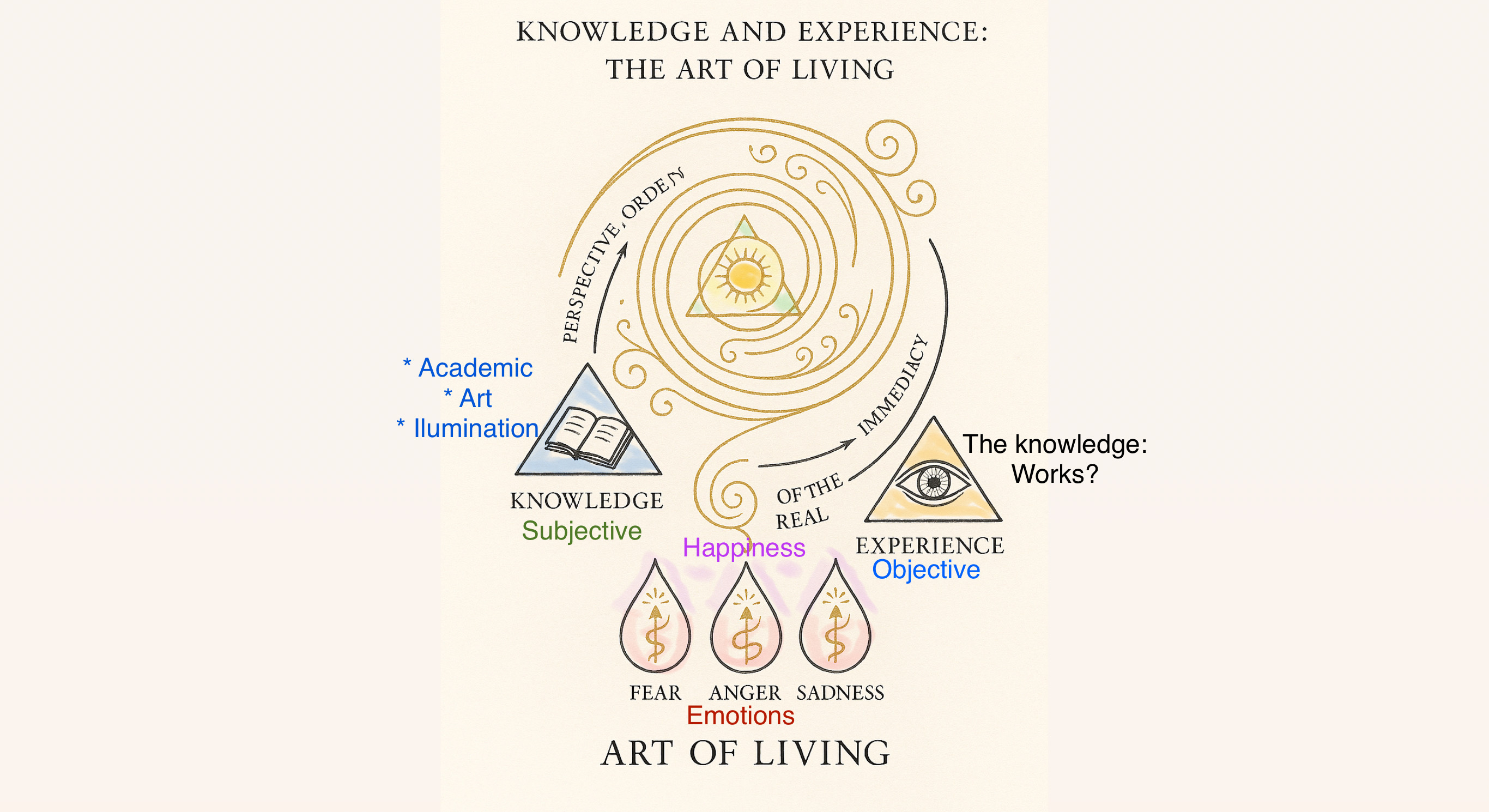
The question before us is essential: how can we integrate unpleasant emotions in such a way that they do not destroy our stability, but rather expand it? The hypothesis guiding this reflection maintains that the key lies in the dynamic conjunction between knowledge and experience. It is only at this intersection that a fertile space opens up—a space in which emotions cease to be mere disturbances and reveal themselves as critical energies, capable of activating and expanding our activities of co-creation alongside universal cosmic consciousness.
Knowledge and experience are not isolated entities, but complementary poles of a closed circle, a spiral of continuous and infinite feedback. Knowledge grants us perspective, structure, and order: it is the map that organizes lived experience into a cartography of subjective reality. Experience, on the other hand, delivers to us the immediacy of the real, the living contrast that confirms, nuances, or disproves the validity of that inner map.
Without knowledge, life is reduced to the blind repetition of patterns, a mechanical transit without meaning or direction. Without experience, knowledge becomes sterile abstraction, floating in a void without contact with concrete existence. Together, in their meeting, they constitute what we might call the art of living: a subtle alchemy in which emotions, both luminous and shadowy, are transformed into sources of wisdom.
The unpleasant emotion, far from being a residue to be eliminated, becomes an indicator of misalignment, a sign that the map of knowledge needs to be expanded or that experience must be reinterpreted. Thus, fear, anger, or sadness cease to be “enemies” and are transfigured into signals of growth, thresholds toward a broader state of consciousness, allowing us to assertively co-create better realities.
This process recalls the work of the alchemist who, working with raw material, recognized that it was precisely in density and impurity that the possibility of transmutation lay. Similarly, unpleasant emotions are the raw matter of our affective life: their integration, through the conjunction of knowledge and experience, allows us to transmute them into lucid and creative energy.
In this sense, we could affirm that human beings do not achieve stability by denying or repressing their negative emotions, but by integrating them into a broader economy of the spirit. Only then do these emotions cease to be destructive forces and become vital currents that expand inner stability, making it deeper, more flexible, and more resilient.
The wisdom that emerges from this process is not static or definitive, but always dynamic: a fabric that is ceaselessly renewed in the living tension between knowing and experiencing, thinking and living, feeling and comprehending. Where this conjunction occurs, emotions, even the harshest ones, reveal themselves as part of Presence itself: not as obstacles to consciousness, but as its most intense fuel.