🧠 Organizational Consciousness Cubes

Transforming vertical hierarchy into a living, cellular, and collaborative network
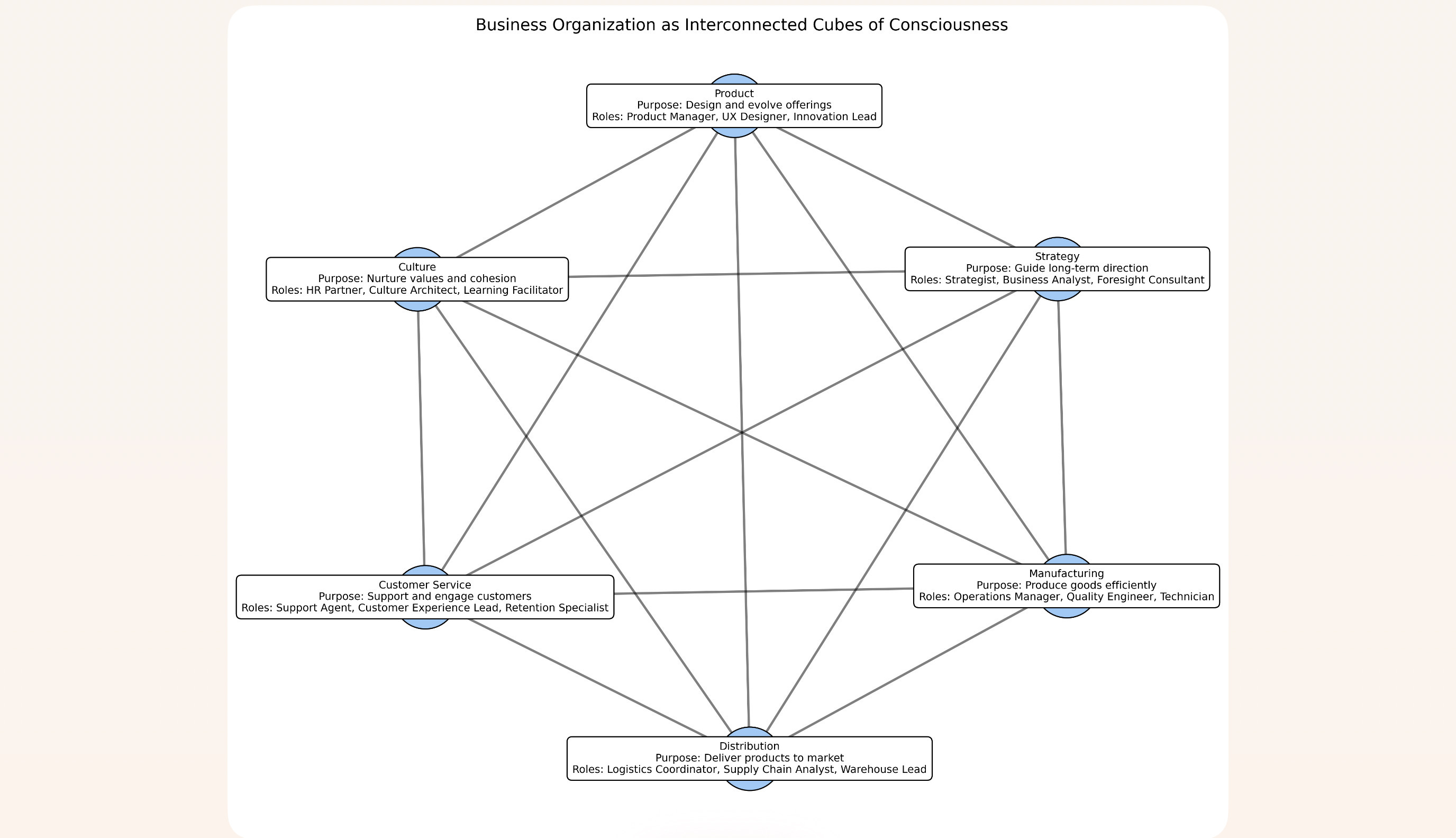
Organizational Model: “Architecture of Conscious Administrative Cubes”
🌐 General Vision. An organization structured as a cellular formation of “conscious administrative cubes” functions like a living system: each cube (team) is autonomous yet interdependent, collaborating omnidirectionally with other cubes.
Each business cube is a unit of meaning, decision, and action, aligned with the common purpose, yet free to adapt, innovate, and evolve.
🧩 Cellular Structure
• Cube = organizational cell: A multifunctional team with dynamic roles, a clear purpose, and operational autonomy.
• Interconnected network: Cubes are linked through flows of information, shared projects, and strategic resonance—not hierarchy.
• Fractal formation: Each cube coherently replicates the logic of the whole: purpose, governance, feedback, and evolution.
🔄 Functional Dynamics
Element. Description.
Functional autonomy. Each cube makes decisions within its domain without waiting for hierarchical approval.
Conscious interdependence. Cubes coordinate through resonance protocols: explicit agreements, purpose synchronization, and continuous feedback.
Dynamic roles. There are no fixed “positions,” but roles that are assigned, rotated, or emerge according to the work flow.
Distributed governance. Strategic decisions are made in circles of cubes, where each has voice and vote.
Purpose as axis. Each cube has a local purpose aligned with the organization’s global purpose.
🧬 Examples of Functional Cubes
Cube. Purpose. Possible Roles
Product Cube. Design and evolve user-centered solutions Designer, feedback facilitator, technical integrator
Culture Cube. Care for the emotional and symbolic coherence of the organization. Guardian of values, internal narrator, mediator.
Customer Cube . Listen, accompany, and co-create with users. Brand ambassador, insight synthesizer, community connector.
Strategy Cube. Align collective direction with a changing environment. Trend anticipator, foresight mapper, vision facilitator
🧠 Philosophical Inspiration: Cubes as Units of Consciousness
• Each cube is like a quantum of organizational consciousness: it perceives, decides, and acts in its immediate environment.
• The entire organization is a field of resonance, where cubes synchronize coherently like neurons in a network.
• There is no fixed center: leadership emerges where needed, like a wave of collective attention.
🌱 Model Benefits
• Evolutionary agility: The organization adapts in all directions like a living network, not linearly like a machine.
• Distributed innovation: Each cube can experiment, learn, and share without waiting for permission.
• Cohesion without control: Coherence arises from the resonance of purposes, not from imposed hierarchy.
• Deep well-being: People feel seen, heard, and co-creators of the whole.
🛠 How to Implement It
1. Map existing cubes: Which units already function as autonomous cells?
2. Define local purposes: What meaning does each cube hold within the whole?
3. Design resonance protocols: How do cubes communicate, synchronize, and provide feedback?
4. Facilitate fluid roles: How are roles assigned and rotated according to the flow?
5. Cultivate collective consciousness: Create spaces for reflection, listening, and deep alignment.
About the author: Carlos Serna II is an engineer, free critical-thinker, and interdisciplinary essayist. He lives in the suburbs of Washington, DC, USA. His scientific-philosophical work explores the boundaries between science, philosophy, and human consciousness, seeking bridges between modern physics and inner experience.