Reality Is Neither Linear Nor Predictable

The Nature of Transformation
The history of a system of reality is open-ended, and uncertainty is a constitutive force in the creativity of the universe.
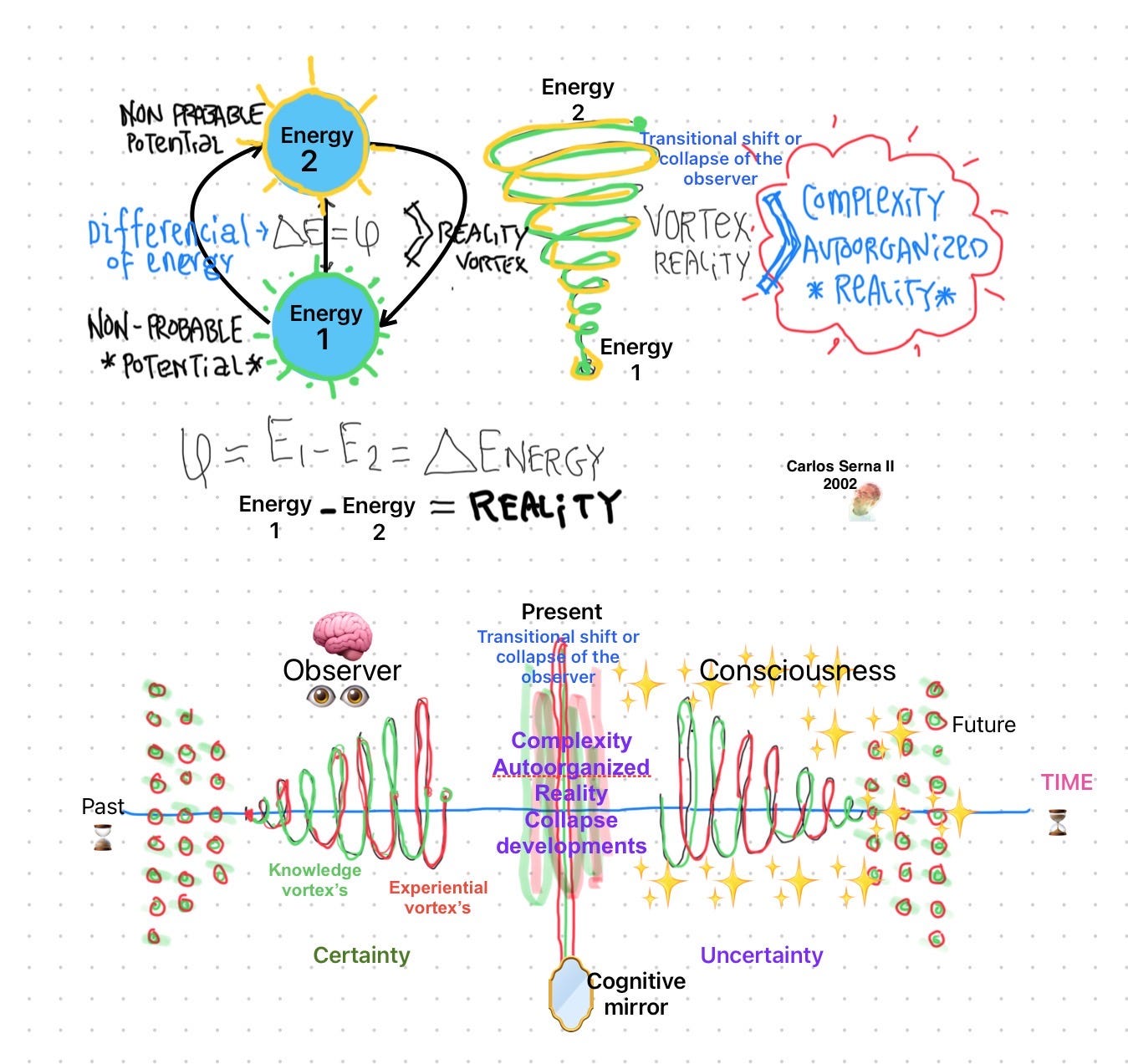
If there are two types of change—one that occurs within a system that remains structurally unaltered, and another whose emergence transforms the system itself—then how might we name the kind of change that occurs between these two poles?
• The first type of change (within a system that remains unchanged) is often called a state change or intrinsic change. The system retains its identity and structure, even as its internal conditions vary.
Example: Water shifting from liquid to gas, or a society changing governments without altering its constitutional framework.
• The second type of change (which transforms the system itself) is understood as structural change, paradigm shift, or even ontological metamorphosis. Here, not only do states change, but the very organization and nature of the system are reconfigured.
Example: A caterpillar becoming a butterfly, or a community evolving from a nomadic tribe into an urban society.
Now, the type of change you propose—situated between these two extremes—could be conceived as:
1. Liminal change: Occurs at a threshold, where internal transformations begin to alter the system’s conditions without yet dissolving its identity entirely.
2. Emergent change: Not merely internal nor fully structural, but one that generates new properties through the interaction of parts, anticipating a reorganization.
3. Transitional change: Marks the passage where internal modifications reach a critical point, beginning to strain and reconfigure the system’s structure.
Philosophically, this intermediate change could be described as a second-order change in gestation: the moment where what once seemed like mere internal variation begins to accumulate to the point of threatening the system’s very form.
🔹 Possible names for this kind of change might include:
• Threshold change
• Emergent mutation
• Ontological transition
Ilya Prigogine developed a rich conceptual framework to think about these intermediate forms of change—not as mere internal adjustments, nor as meaningless structural collapse, but as processes in which the system reorganizes itself out of disorder.
1. Dissipative Systems and Non-Equilibrium
Prigogine showed that open systems—those that exchange energy and matter with their environment—do not simply tend toward equilibrium (as classical thermodynamics claimed), but can maintain and generate order through constant energy flow. He called these dissipative systems.
In this context, change is not reduced to two extremes (internal adjustment or total transformation), but a third mode of change appears:
• When the system is pushed far from equilibrium, its internal fluctuations amplify
• Critical instabilities arise
• And the system “chooses” among different paths of reorganization
2. Bifurcation Points
Between internal change and radical structural transformation, Prigogine speaks of bifurcations: critical moments where internal dynamics reach a threshold that opens multiple possibilities.
• Before the bifurcation: Changes are absorbed without altering the system’s global identity
• At the bifurcation: Internal dynamics begin to reorganize the structural level, and new orders emerge
• After the bifurcation: The system may reorganize into a new stable structure—or collapse
Thus, this intermediate type of change can be understood as bifurcational change, or even dissipative transition: a change in which internal dynamics become the seed of global metamorphosis.
3. Scientific and Philosophical Implications
• Scientifically, this concept connects with phenomena such as pattern emergence in physics (e.g., convective structures), biological self-organization, and neural dynamics that give rise to states of consciousness.
• Philosophically, it implies that reality is neither linear nor predictable: the history of a system of reality is open-ended, and uncertainty is a constitutive force in the creativity of the universe.
💡 Thus, what I propose as “intermediate change” can be read, through Prigogine’s lens, as the moment of bifurcation: the space where a system, under tension, opens to the unpredictable and generates novelty.