Reality. Part I

From my book, I will share with you my ideas under the following format:
On the Concept of "Reality": A Framework
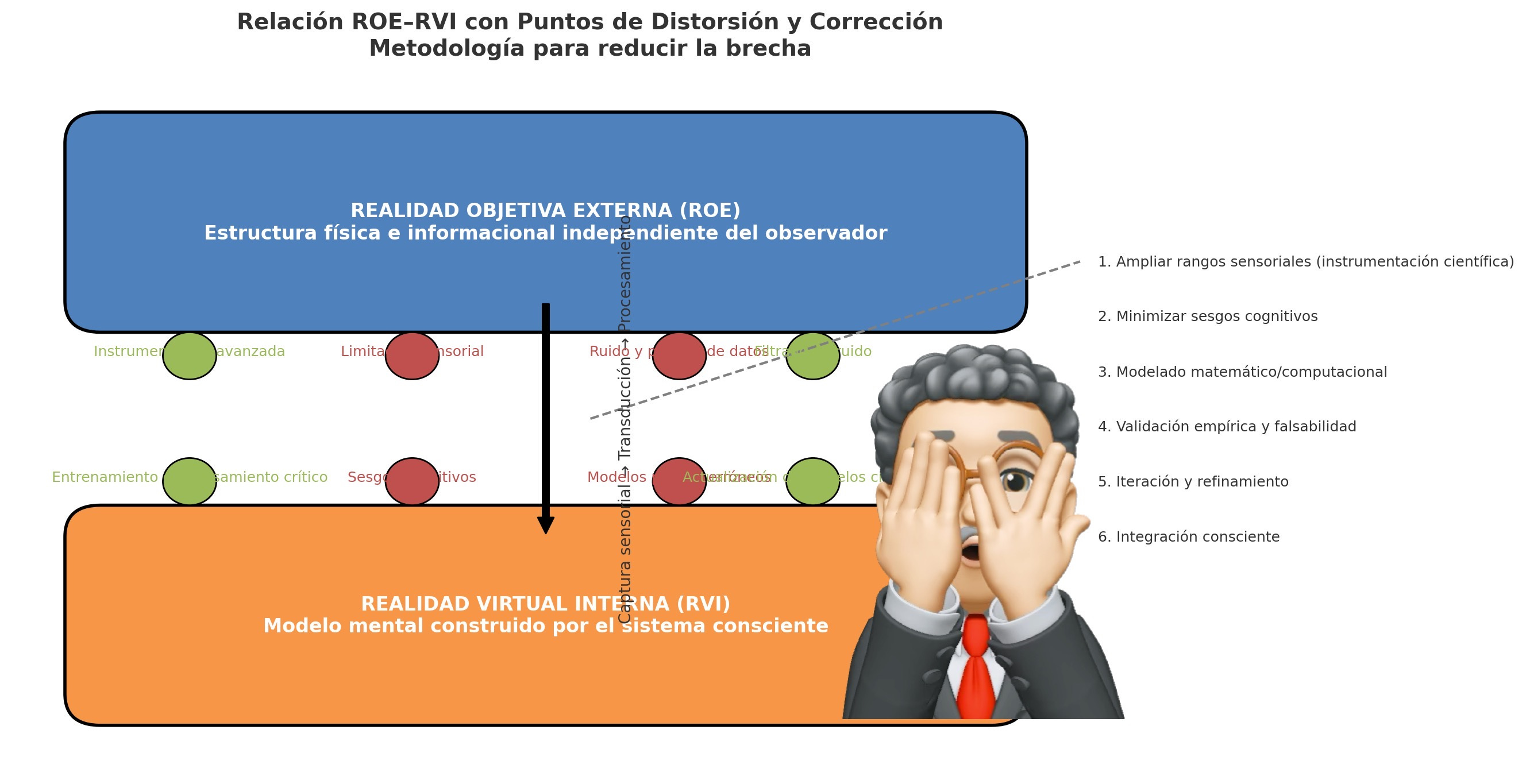
💡 Core Thesis: The ultimate purpose of understanding reality is not merely to ensure survival or optimize biological adaptation, but to minimize—with the greatest possible precision—the gap between what is and what we perceive to be. This endeavor demands a convergence of knowledge, where science, philosophy, and technology serve as complementary tools to unravel the structure and nature of reality.
I. Tools for Inquiry
Fundamental Physics (integrates classical physics, relativity, and quantum mechanics)
Contribution: Rigorous mathematical models of observable phenomena and universal laws.
Limitation: Does not address the ultimate why of existence, and its interpretations—especially in quantum domains—remain contested.
Epistemology and Philosophy of Science
Contribution: A critical framework to distinguish beliefs, hypotheses, theories, and empirical facts.
Limitation: Lacks direct empirical capacity; relies on other disciplines to test its constructs.
Information Theory
Contribution: A potential unification of physics and computation, positing information as more fundamental than matter.
Limitation: Requires an ontology to explain the ultimate substrate of such information.
Neuroscience and Consciousness Studies
Contribution: Explanations for the emergence of subjective experience and its ties to the physical world.
Limitation: Fails to resolve Chalmers’ "hard problem" of consciousness.
Evolutionary Biology
Contribution: The adaptive lens: our perception reflects what is useful for survival, not necessarily what is objectively true.
Limitation: Describes cognitive biases, not the universe’s fundamental structure.
Artificial Intelligence and Computational Cognitive Science
Contribution: Functional models of reality as decision-making tools, devoid of phenomenology.
Limitation: AI operates statistically; it lacks subjective experience.
Philosophy of Mind and Ontology
Contribution: Frameworks to debate whether reality is physical, mental, or dual.
Limitation: Depends on scientific evidence to ground its speculations.
Integrative Approach
For a critical, multidimensional realism, the proposed synthesis:
Chapter 1: Fundamental Physics + Information Theory → Structure and dynamics of the universe.
Chapter 2: Epistemology → Model validation and refinement.
Chapter 3: Neuroscience + Evolutionary Biology → Limits of human perception.
Chapter 4: AI + Philosophy of Mind → Expanding representational models.
This framework acknowledges a mind-independent reality while emphasizing that all access to it is mediated by biological, cognitive, and technological tools.
Español:
Desde mi libro: Consciencia, Realidad y Tiempo; Compartiré contigo mis ideas en el siguiente formato.
Sobre el concepto de "realidad": desarrollo conceptual
💡 Idea central: El fin último de comprender la realidad no se reduce a garantizar la supervivencia ni a optimizar la adaptación biológica, sino a minimizar —con la máxima precisión— la brecha entre lo que es y lo que percibimos que es. Este esfuerzo requiere una convergencia de saberes, donde la ciencia, la filosofía y la tecnología actúen como herramientas complementarias para desentrañar la estructura y esencia de lo real.
I. Herramientas de aproximación
Física fundamental (integra física clásica, relatividad y mecánica cuántica)
Aporta: Modelos matemáticos rigurosos de los fenómenos y leyes del universo observable.
Limitación: No explica el porqué último de la existencia, y sus interpretaciones —especialmente en el ámbito cuántico— siguen siendo controvertidas.
Epistemología y filosofía de la ciencia
Aporta: Un marco crítico para distinguir entre creencias, hipótesis, teorías y hechos verificables.
Limitación: Carece de capacidad empírica directa; depende de otras disciplinas para contrastar sus postulados.
Teoría de la información
Aporta: Una posible unificación entre física y computación, proponiendo que la información es más fundamental que la materia.
Limitación: Requiere una ontología que explique el sustrato último de dicha información.
Neurociencia y ciencia de la consciencia
Aporta: Explicaciones sobre el origen de la experiencia subjetiva y su vínculo con lo físico.
Limitación: No resuelve el "problema duro" de la consciencia (Chalmers).
Biología evolutiva
Aporta: La perspectiva adaptativa: nuestra percepción refleja lo útil para sobrevivir, no necesariamente lo objetivo.
Limitación: No describe la estructura última del universo, solo los sesgos de nuestra cognición.
Inteligencia Artificial y ciencias cognitivas computacionales
Aporta: Modelos de representación basados en utilidad funcional, no en experiencia fenomenológica.
Limitación: La IA opera en un plano estadístico; carece de subjetividad.
Filosofía de la mente y ontología
Aporta: Categorías para debatir si la realidad es física, mental o dual.
Limitación: Depende de hallazgos científicos para sustentar sus reflexiones.
Enfoque integrador
Para un realismo crítico y multidimensional, propongo cuatro capítulos básicos:
Capítulo 1: Física fundamental + Teoría de la información → Estructura y dinámica del universo.
Capítulo 2: Epistemología → Depuración y validación de modelos.
Capítulo 3: Neurociencia + Biología evolutiva → Límites de la percepción humana.
Capítulo 4: IA + Filosofía de la mente → Expansión de modelos representacionales.
Este marco reconoce una realidad independiente de la mente, pero advierte que todo acceso a ella está mediado por herramientas biológicas, cognitivas y tecnológicas.