The Coherent Order Behind Universal Expansion

Origins, Functional Characteristics, and Emergent Realities
Español English
Author: Prof. Eng. Carlos Serna II, PE MS LSSBB
Introduction
The universe, as observed today, exhibits a remarkably coherent structure that emerges from the seemingly chaotic phenomena of cosmic expansion. While the initial stages of this expansion were marked by randomness and high entropy, a distinct pattern of order and complexity began to manifest over time. This order, which underpins the formation of galaxies, stars, and other cosmic structures, raises profound questions regarding the origins, nature, and implications of such coherence within the framework of the universe’s expansion. Scientific studies across cosmology, quantum physics, and systems theory provide valuable insights into the emergence of this complex order. In this essay, we will explore the origins of this order, its functional characteristics, and its influence on observable reality.
Origins of Coherent Order: The Early Universe
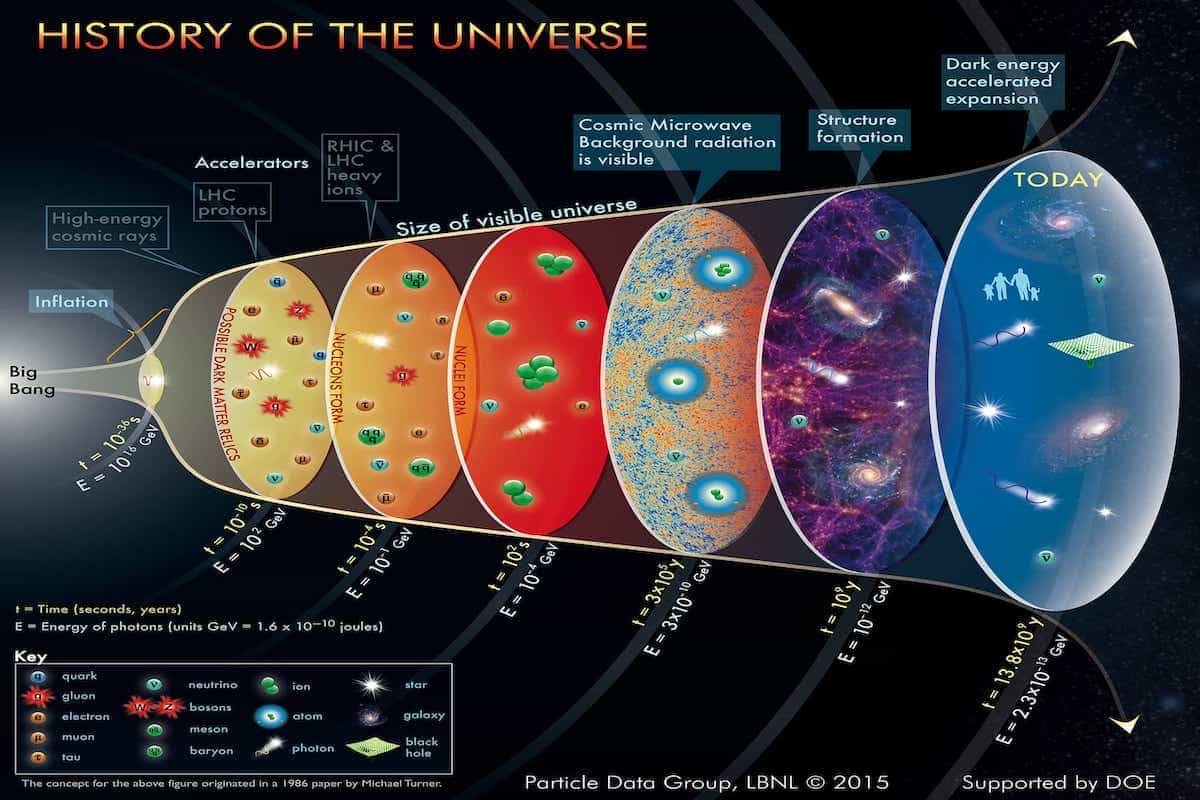
The coherent order within the universe can be traced back to the initial conditions set by the Big Bang. According to the standard cosmological model, the universe began approximately 13.8 billion years ago as an extremely hot and dense singularity that rapidly expanded in a process known as cosmic inflation (Guth, 1981; Linde, 1983). This inflationary period, lasting only a fraction of a second, played a crucial role in establishing the homogeneity and isotropy of the observable universe.
The primordial fluctuations generated during inflation—tiny variations in the density of matter and energy—were subsequently amplified by gravitational interactions, forming the initial “seeds” of large-scale structure (Hawking & Moss, 1982). These fluctuations, as observed in the cosmic microwave background (CMB) radiation, represent the first signs of the emergent order, which later evolved into galaxies and cosmic filaments (Planck Collaboration, 2018). Quantum field theories suggest that these fluctuations were influenced by fundamental forces and particles, contributing to the universe’s eventual organization into stable structures.
Functional Characteristics of Coherent Order
The coherent order in the universe is not static; it exhibits dynamic and self-organizing properties, which can be understood through principles of symmetry, entropy minimization, and nonlinear dynamics. One of the fundamental characteristics of this order is the hierarchical organization of matter. On the largest scales, the universe is structured into a cosmic web composed of galaxies, clusters, and superclusters interconnected by vast filaments and separated by voids (Bond, Kofman, & Pogosyan, 1996). This pattern reflects a balance between gravitational attraction and the repulsive effects of dark energy, which drives the universe’s accelerated expansion.
On smaller scales, coherent order manifests through the self-organization of complex systems. For example, the formation of stars and planetary systems is governed by feedback loops between gravitational collapse, thermonuclear fusion, and angular momentum conservation (Hoyle, 1953). These interactions create stable configurations that minimize energy while maintaining structural coherence.
Additionally, the concept of emergence is central to understanding this order. Emergence refers to the phenomenon where complex properties arise from simpler interactions without a central guiding principle. In cosmology, emergent phenomena include the appearance of galactic clusters, black holes, and even the formation of life-supporting planets. Such emergent realities suggest that the universe has an inherent capacity for self-organization, resulting in structures that are functionally diverse yet interconnected.
Effects on Observable Reality
The coherent order in the universe has profound implications for both cosmological and philosophical interpretations of reality. First, this order governs the distribution of matter and energy, shaping the observable universe and determining the conditions under which galaxies, stars, and planets form. The anthropic principle, which posits that the universe’s fundamental constants are finely tuned to allow for the emergence of life, is one consequence of this coherence (Barrow & Tipler, 1986). The improbability of such fine-tuning suggests that the observed order may either be the result of a deeper, yet unknown principle, or indicative of a multiverse scenario, where only certain universes possess the right conditions for complex life.
Second, the order observed in the universe challenges the traditional notion of entropy. According to the second law of thermodynamics, the entropy (or disorder) of a closed system should always increase. However, the universe exhibits a paradoxical tendency toward local decreases in entropy—such as the formation of stars, planets, and living organisms—within an overall context of increasing entropy. This phenomenon is explained by the gravitational potential energy of large-scale structures, which drives the universe toward configurations of higher complexity despite the background trend of entropy increase (Penrose, 1989).
Finally, the emergent order of the universe has implications for our understanding of reality itself. Concepts such as spontaneous symmetry breaking—where symmetric states evolve into asymmetrical ones—demonstrate that the universe’s order is not static but the result of continuous processes of differentiation and self-organization (Anderson, 1972). This dynamic nature of order suggests that reality is an ongoing process of becoming, characterized by transitions between chaos and order, and marked by the emergence of new properties and entities.
Conclusion
The coherent order that underpins the universe’s expansion is an intricate and dynamic phenomenon, reflecting the interplay between initial conditions, fundamental forces, and emergent properties. From the primordial fluctuations of the early universe to the hierarchical structures observed in the cosmic web, this order shapes the observable reality and influences the formation of complex systems. While much remains to be understood about the precise mechanisms driving this coherence, scientific research continues to uncover the underlying principles that transform chaos into structured complexity. Understanding this order not only advances our knowledge of the cosmos but also offers insights into the nature of reality itself, revealing a universe that is both structured and in perpetual transformation.
References
• Anderson, P. W. (1972). More is different: Broken symmetry and the nature of the hierarchical structure of science. Science, 177(4047), 393-396.
• Barrow, J. D., & Tipler, F. J. (1986). The Anthropic Cosmological Principle. Oxford University Press.
• Bond, J. R., Kofman, L., & Pogosyan, D. (1996). How filaments of galaxies are woven into the cosmic web. Nature, 380(6575), 603-606.
• Guth, A. H. (1981). Inflationary universe: A possible solution to the horizon and flatness problems. Physical Review D, 23(2), 347-356.
• Hawking, S. W., & Moss, I. G. (1982). Supercooled phase transitions in the very early universe. Physics Letters B, 110(1), 35-38.
• Hoyle, F. (1953). On the formation of stars. The Astrophysical Journal, 118, 513-528.
• Linde, A. D. (1983). Chaotic inflation. Physics Letters B, 129(3-4), 177-181.
• Penrose, R. (1989). The Emperor’s New Mind: Concerning Computers, Minds, and the Laws of Physics. Oxford University Press.
• Planck Collaboration. (2018). Planck 2018 results: Cosmological parameters. Astronomy & Astrophysics, 641, A6.
Español
El Orden Coherente Detrás de la Expansión Universal: Orígenes, Características Funcionales y Realidades Emergentes
Autor: Prof. Eng. Carlos Serna II, PE MS LSSBB.
Introducción
El universo, tal como lo observamos hoy en día, exhibe una estructura notablemente coherente que surge de los fenómenos aparentemente caóticos de la expansión cósmica. Mientras que las etapas iniciales de esta expansión estuvieron marcadas por aleatoriedad y alta entropía, con el tiempo se comenzó a manifestar un patrón distintivo de orden y complejidad. Este orden, que sustenta la formación de galaxias, estrellas y otras estructuras cósmicas, plantea preguntas profundas sobre los orígenes, la naturaleza y las implicaciones de dicha coherencia en el contexto de la expansión del universo. Los estudios científicos en cosmología, física cuántica y teoría de sistemas proporcionan perspectivas valiosas para comprender la emergencia de este orden complejo. En este ensayo, exploraremos los orígenes de este orden, sus características funcionales y su influencia en la realidad observable.
Orígenes del Orden Coherente: El Universo Primitivo
El orden coherente dentro del universo puede rastrearse hasta las condiciones iniciales establecidas por el Big Bang. Según el modelo cosmológico estándar, el universo comenzó hace aproximadamente 13.8 mil millones de años como una singularidad extremadamente caliente y densa que se expandió rápidamente en un proceso conocido como inflación cósmica (Guth, 1981; Linde, 1983). Este período inflacionario, que duró solo una fracción de segundo, jugó un papel crucial en el establecimiento de la homogeneidad e isotropía del universo observable.
Las fluctuaciones primordiales generadas durante la inflación —pequeñas variaciones en la densidad de materia y energía— fueron posteriormente amplificadas por interacciones gravitacionales, formando las “semillas” iniciales de la estructura a gran escala (Hawking & Moss, 1982). Estas fluctuaciones, como se observa en la radiación de fondo cósmico de microondas (CMB), representan las primeras señales del orden emergente, que más tarde evolucionó en galaxias y filamentos cósmicos (Planck Collaboration, 2018). Las teorías de campos cuánticos sugieren que estas fluctuaciones fueron influenciadas por fuerzas y partículas fundamentales, contribuyendo a la eventual organización del universo en estructuras estables.
Características Funcionales del Orden Coherente
El orden coherente en el universo no es estático; exhibe propiedades dinámicas y de autoorganización, las cuales pueden entenderse a través de los principios de simetría, minimización de entropía y dinámica no lineal. Una de las características fundamentales de este orden es la organización jerárquica de la materia. A la mayor escala, el universo está estructurado en una red cósmica compuesta de galaxias, cúmulos y supercúmulos interconectados por vastos filamentos y separados por vacíos (Bond, Kofman, & Pogosyan, 1996). Este patrón refleja un equilibrio entre la atracción gravitacional y los efectos repulsivos de la energía oscura, que impulsa la expansión acelerada del universo.
A escalas más pequeñas, el orden coherente se manifiesta a través de la autoorganización de sistemas complejos. Por ejemplo, la formación de estrellas y sistemas planetarios se rige por bucles de retroalimentación entre el colapso gravitacional, la fusión termonuclear y la conservación del momento angular (Hoyle, 1953). Estas interacciones crean configuraciones estables que minimizan la energía mientras mantienen la coherencia estructural.
Además, el concepto de emergencia es central para comprender este orden. La emergencia se refiere al fenómeno en el cual propiedades complejas surgen de interacciones más simples sin un principio guía central. En cosmología, los fenómenos emergentes incluyen la aparición de cúmulos galácticos, agujeros negros e incluso la formación de planetas capaces de sustentar vida. Tales realidades emergentes sugieren que el universo tiene una capacidad inherente de autoorganización, resultando en estructuras que son funcionalmente diversas pero interconectadas.
Efectos sobre la Realidad Observable
El orden coherente en el universo tiene profundas implicaciones tanto para las interpretaciones cosmológicas como filosóficas de la realidad. En primer lugar, este orden rige la distribución de materia y energía, dando forma al universo observable y determinando las condiciones bajo las cuales se forman galaxias, estrellas y planetas. El principio antrópico, que postula que las constantes fundamentales del universo están ajustadas de manera precisa para permitir la emergencia de la vida, es una consecuencia de esta coherencia (Barrow & Tipler, 1986). La improbabilidad de tal ajuste sugiere que el orden observado puede ser el resultado de un principio más profundo aún desconocido o indicar un escenario de multiverso, donde solo ciertos universos poseen las condiciones adecuadas para la vida compleja.
En segundo lugar, el orden observado en el universo desafía la noción tradicional de la entropía. Según la segunda ley de la termodinámica, la entropía (o desorden) de un sistema cerrado debería siempre aumentar. Sin embargo, el universo exhibe una tendencia paradójica hacia disminuciones locales de entropía —como la formación de estrellas, planetas y organismos vivos— dentro de un contexto general de aumento de entropía. Este fenómeno se explica por la energía potencial gravitatoria de las estructuras a gran escala, la cual impulsa al universo hacia configuraciones de mayor complejidad a pesar de la tendencia general de incremento de entropía (Penrose, 1989).
Finalmente, el orden emergente del universo tiene implicaciones para nuestra comprensión de la realidad misma. Conceptos como la ruptura espontánea de simetría —donde los estados simétricos evolucionan hacia otros asimétricos— demuestran que el orden del universo no es estático, sino el resultado de procesos continuos de diferenciación y autoorganización (Anderson, 1972). Esta naturaleza dinámica del orden sugiere que la realidad es un proceso continuo de devenir, caracterizado por transiciones entre caos y orden, y marcado por la emergencia de nuevas propiedades y entidades.
Conclusión
El orden coherente que sustenta la expansión del universo es un fenómeno intrincado y dinámico, reflejando la interacción entre las condiciones iniciales, las fuerzas fundamentales y las propiedades emergentes. Desde las fluctuaciones primordiales del universo temprano hasta las estructuras jerárquicas observadas en la red cósmica, este orden moldea la realidad observable e influye en la formación de sistemas complejos. Aunque mucho queda por entender sobre los mecanismos precisos que impulsan esta coherencia, la investigación científica continúa revelando los principios subyacentes que transforman el caos en complejidad estructurada. Comprender este orden no solo avanza nuestro conocimiento del cosmos, sino que también ofrece perspectivas sobre la naturaleza misma de la realidad, revelando un universo que es a la vez estructurado y en perpetua transformación.
References
• Anderson, P. W. (1972). More is different: Broken symmetry and the nature of the hierarchical structure of science. Science, 177(4047), 393-396.
• Barrow, J. D., & Tipler, F. J. (1986). The Anthropic Cosmological Principle. Oxford University Press.
• Bond, J. R., Kofman, L., & Pogosyan, D. (1996). How filaments of galaxies are woven into the cosmic web. Nature, 380(6575), 603-606.
• Guth, A. H. (1981). Inflationary universe: A possible solution to the horizon and flatness problems. Physical Review D, 23(2), 347-356.
• Hawking, S. W., & Moss, I. G. (1982). Supercooled phase transitions in the very early universe. Physics Letters B, 110(1), 35-38.
• Hoyle, F. (1953). On the formation of stars. The Astrophysical Journal, 118, 513-528.
• Linde, A. D. (1983). Chaotic inflation. Physics Letters B, 129(3-4), 177-181.
• Penrose, R. (1989). The Emperor’s New Mind: Concerning Computers, Minds, and the Laws of Physics. Oxford University Press.
• Planck Collaboration. (2018). Planck 2018 results: Cosmological parameters. Astronomy & Astrophysics, 641, A6.