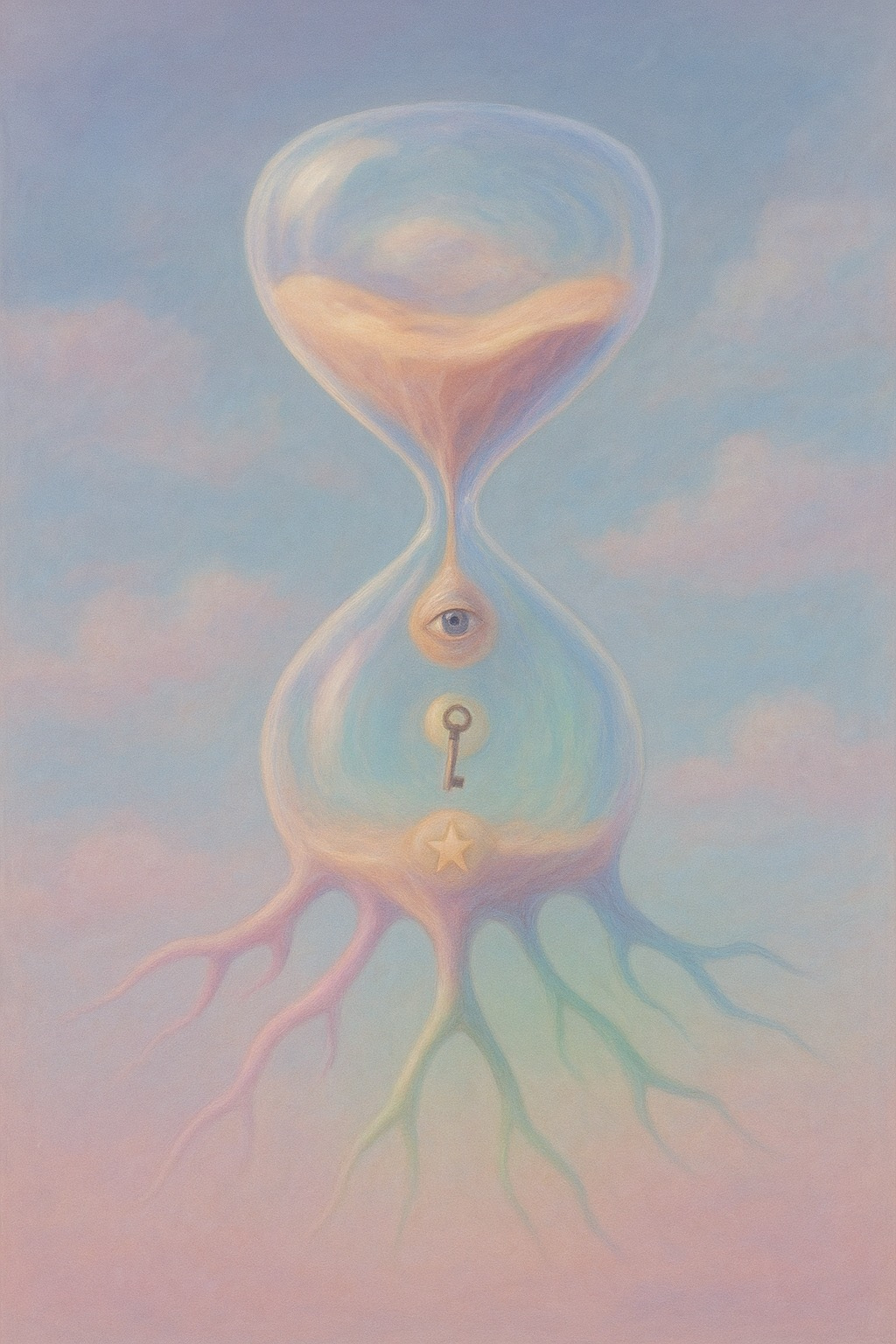
The truth

"Universal Cosmic Consciousness is the common background that expresses itself in the diversity of mystical and scientific experiences. The uniqueness of each human biography translates this unity into multiple narratives, irreducible to one another yet profoundly resonant. Therefore, truth cannot be imposed as dogma; it can only be shared as testimony, as a spark of a singular Presence that recognizes itself in every face, in every tradition, and in every scientific discovery.
Although everything arises from the same Consciousness, describing one's own vision as absolute can obstruct the revelation of the other. Silence, dialogue, and humility thus become the most faithful ways to honor the unity that beats within the plurality."
CSII
The state of being factual, a true statement, or a spiritual reality.
The Unity of Consciousness and the Limit of Its Individual Expression
Introduction
We begin from a radical metaphysical hypothesis: there exists a single universal cosmic Consciousness, the ground and origin of all that is real. Each human individual is nothing more than a fold, a particularized form of that Consciousness, so that the experience of their reality is unique, even though it is rooted in the same source.
This framework poses an epistemological and ethical paradox: if we all share the same root, why is it not always appropriate to describe to others the truth one perceives and co-creates? The answer, as argued here, is linked to the limits of language, the symbolic nature of every expression, and the ethical responsibility of communication.
1. One Consciousness, Multiple Perspectives
The idea of a universal consciousness is not new. In Vedantic tradition, Atman (the self) and Brahman (the absolute) are declared identical in the famous formula tat tvam asi (“you are that”).¹ In Neoplatonism, Plotinus maintains that all being emanates from the One and remains within it: “Everything that exists is present in the One, and yet is not distinct from it.”²
In modernity, this intuition resurfaces in different forms: from Jung’s notion of the collective unconscious to holistic quantum theories such as Bohm’s, who proposed an “implicate order” in which the whole of reality is contained in every point of the cosmos.³
If we accept this hypothesis, each individual is not a closed entity, but a mode of expression. Just as the ocean folds into waves, Consciousness folds into biographies. The truth each person perceives is true at its root, but it appears as partial and situated.
2. The Limit of Language
The passage from experience to word introduces an unbridgeable distance. This descriptive limitation arises from the degree of knowledge each individual has been able to verify through personal experience. Wittgenstein expressed it bluntly: “Whereof one cannot speak, thereof one must remain silent.”⁴ The absolute, once named, becomes a discursive object and is therefore inevitably reduced.
Hence the caution of mystical traditions, which highlight the insufficiency of language, underpinned by the limits of cognitive capacity to describe such experiences. The Tao Te Ching begins with the warning: “The Tao that can be spoken is not the eternal Tao.”⁵ Language cannot capture the ineffable; it can only circle it with symbols and paradoxes.
Thus, although the root of experience is shared, its translation into words is never universal: it depends on cultural metaphors, grammatical structures, and horizons of meaning. Shared truth runs the risk of being mistaken for dogma if its character as translation is forgotten.
3. Truth as a Shared Symbol
In this framework, the “truth” each individual perceives is not an absolute object, but a personal symbol of the universal. Jung puts it this way:
“The symbol cannot be invented; it arises spontaneously, carrying with it a meaning that surpasses individual consciousness and points to the collective background.”⁶
Similarly, Ricoeur affirms that the symbol “gives rise to thought.”⁷ Its function is not to replace reality but to suggest it, to point toward the ungraspable from the finite.
From this follows that describing one’s own truth should not be understood as transmitting a definitive content, but as offering a symbolic testimony.
4. The Ethics of Sharing Truth
If every individual truth is a partial expression of the same Consciousness, the act of communicating it demands responsibility. Three basic principles emerge from this perspective:
1. Epistemic humility: recognizing that every expression is limited. In Chalmers’ words, consciousness is “the hard problem” because its phenomenal quality can never be completely reduced to objective explanations.⁸
2. Hermeneutical hospitality: listening to another’s truth as another window onto the same ground. Gadamer formulated this as a “fusion of horizons.”⁹
3. Expressive prudence: discerning when words should give way to silence, metaphor, or ritual gesture. Sometimes imposing a narrative may interrupt the other’s process of recognizing their own connection to Consciousness.
5. Provisional Conclusion
The hypothesis of a single Consciousness leads us to a delicate point: each individual vision is partial yet authentic, and all participate in the same root. Truth, then, cannot be understood as an absolute object but as a relational event, born from the crossing of singular perspectives that point back to a shared ground.
Hence it is not always advisable to describe one’s own truth to others: not because it is false, but because every expressed truth is fragmentary and risks becoming an imposition. Speaking and remaining silent are, within this horizon, equally fertile gestures: both allow universal Consciousness to recognize itself in its multiplicity.
6. Convergences in Diversity: Christian Mysticism, Buddhism, and Contemporary Neuroscience
6.1. Christian Mysticism: The “Spark of the Soul” and Union in Love
In the Christian mystical tradition, far from conceiving God as an external being, He is understood as the very foundation of being. Meister Eckhart describes a “spark” (Seelenfünklein) in the depths of the soul that is identical to God.¹⁰ This intuition is not far from the Vedantic thesis that the deep self is identical to the absolute.
John of the Cross, for his part, notes that the experience of union is ineffable:
*I lost myself and forgot myself,
My face reclined on the Beloved;
All ceased, I let myself go,
Leaving my cares
Forgotten among the lilies.*¹¹
Here, personal truth becomes a silence shared in love, transcending the need to communicate. The “spark” does not seek to impose itself as dogma, but to recognize itself in the intimacy of the other.
6.2. Buddhism: Śūnyatā and Emptiness as Common Ground
Buddhism, particularly in Nāgārjuna’s Madhyamaka school, offers a distinct yet complementary framework: emptiness (śūnyatā) is not absence, but the condition of interdependence. Every phenomenon lacks its own essence and subsists within the background of universal interrelation.¹²
Meditative experience seeks precisely this recognition of shared ground. Zen emphasizes the impossibility of clinging to a definitive “personal truth.” A famous kōan says: “If you meet the Buddha on the road, kill him.”¹³ This suggests that any formulation of truth, however true it may seem, becomes an obstacle if absolutized.
Thus, Buddhism and Christian mysticism converge in their warning: the truth of the One Consciousness can be experienced but not possessed. It is revealed in lived experience, not in conceptualization.
6.3. Contemporary Neuroscience: Correlates Without Reducing the Experience
In recent decades, neuroscience has sought to understand states of deep consciousness. Neuroimaging studies on Buddhist meditators and Christian contemplative monks have revealed common patterns: reduced activity in the superior parietal lobe (linked to self-boundary perception) and increased activation of the prefrontal cortex (linked to sustained attention).¹⁴
These findings suggest that the experience of ego dissolution and unity with the whole has identifiable neural correlates. However, such correlation does not equal reduction. As Varela, neuroscientist and practicing Buddhist, warns:
“Neuroscience can describe the mechanisms, but it does not exhaust the phenomenon. Consciousness is not explained, it is lived.”¹⁵
Similarly, neuroscientist Evan Thompson proposes a science of consciousness in dialogue with phenomenology and contemplative traditions, stressing that subjectivity is irreducible to the purely objective.¹⁶
6.4. A Shared Horizon
When these perspectives are brought together, a common pattern appears:
• Christian mysticism: union in love and silence as the language of the absolute.
• Buddhism: emptiness as universal background dissolving conceptual fixations.
• Neuroscience: observable correlates that allow study of conditions without exhausting the experience.
All agree that ultimate truth is experiential, ineffable, and shared in the background, even if expressed in different narratives.
Thus, the initial caution is reinforced: it is not always good to describe one’s personal truth as absolute, for each cultural and biographical framework translates it differently. The One Consciousness expresses itself as symbolic plurality, and caring for it requires humility, openness, and listening.
Final Thesis
Universal Cosmic Consciousness as the Common Ground of Mystical Traditions and Contemporary Scientific Though
The hypothesis of a single universal cosmic Consciousness—the foundation of being and origin of all manifestation—finds remarkable resonances in seemingly distant domains: Christian mysticism, Buddhism, and neuroscience. Despite cultural and methodological differences, each of these fields offers keys that, placed in dialogue, suggest a profound convergence: the unity of the experience of consciousness beyond its multiple symbolic translations.
1. Christian mysticism: union in love as expression of unity.
2. Buddhism: emptiness and interdependence as the face of the absolute.
3. Neuroscience: correlates of the experience without reducing its depth.
Comparative synthesis:
• Christian mysticism: love as recognition of the absolute.
• Buddhism: emptiness as universal background of interdependence.
• Neuroscience: observable correlates revealing common patterns without exhausting the experience.
Together they converge in one intuition: individual consciousness is not an isolated phenomenon, but an expression of a unique, fertile, ineffable ground.
Thus, truth cannot be imposed as dogma; it can only be shared as testimony, as a spark of a unique Presence that recognizes itself in every face, in every tradition, and in every scientific discovery.
Silence, dialogue, and humility then become the most faithful ways of honoring the unity that pulses within plurality.
Bibliography is available at the Español version of this essay.